The More Gear, the Easier the Trip?
More gear does not always make a four-wheel-drive trip easier. Sort equipment by purpose and frequency to choose what suits the route and vehicle.
Does carrying more gear make a four-wheel-drive trip easier? A gear list for a four-wheel-drive trip should match the route, vehicle and people travelling, not a vague sense that extra equipment is always safer. Each item needs a distinct job, a suitable place in the load and a reason to come along on this journey.
Four-wheel-drive trip gear needs a clear purpose
Equipment earns its space when it answers a specific need: cooking, shelter, navigation, recovery, repair or comfort. “It might come in handy” is a weak reason on its own. It can lead to duplicate tools, specialist gadgets that do not suit the vehicle, and bulky items that add little to the trip.
Start with the journey you are actually taking. Consider the vehicle, passengers, planned stops, likely conditions and what you could do if an item were unavailable. Gear for a remote overnight journey may be unnecessary on a short tour with regular access to services. A rarely used tool might still make sense if it addresses a credible problem and you know how to use it.
Write down the problem each item is meant to solve before packing it.
Sort gear by purpose and frequency of use
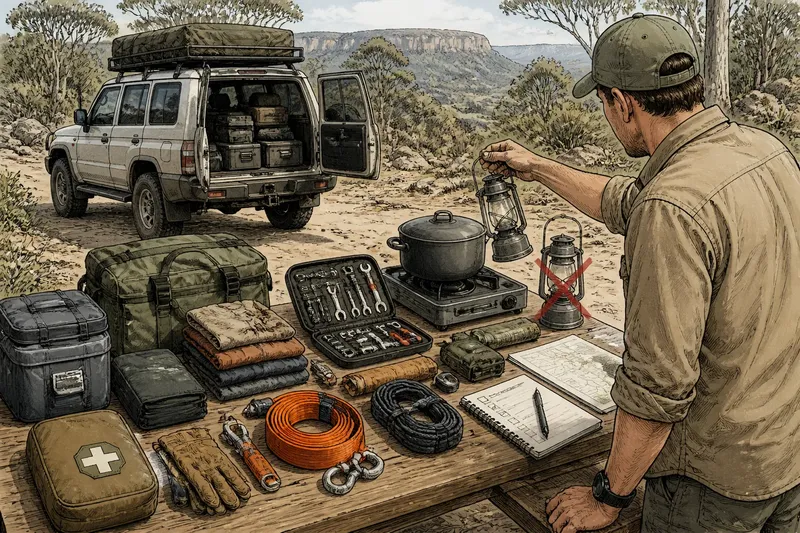
Lay the proposed equipment out before loading the vehicle. Give each item a purpose and note when you expect to use it. Then check each item against the trip rather than treating the categories as automatic reasons to pack it.
- Routine essentials: Check whether items such as water containers, a cooking kit and everyday clothing suit the people and planned stops; if they do, pack the appropriate kit, but if an item has no role on this trip, leave it out.
- Contingency equipment: Check whether a tool such as a puncture repair kit suits the vehicle and a plausible route problem; if it does and you can use it, carry it in a suitable location, but if not, seek suitable advice or leave it out.
- Optional comforts: Check whether a chair or extra cooking item fits the available space and expected routine; if it will be used without displacing more relevant gear, take it, but if it adds bulk without a clear benefit, leave it behind.
Frequency helps set priorities, but it does not settle every decision. Daily-use items should be straightforward to access. A contingency item can still earn its place when unused, provided it addresses a specific risk, is in suitable condition and can be used appropriately. If you cannot name the problem it solves, reconsider packing it.
Match the load to the kind of journey
On a short, serviced tour, keep the load lean. If you will stay in established accommodation or camp near facilities, focus on daily clothing, food and drink, navigation and the vehicle’s normal equipment. A large camp kitchen or several backup items may add bulk without making the journey more workable. Carry contingency gear when it fits a plausible need on the route.
On a remote journey, choose relevant contingencies. If help or replacement supplies may be difficult to reach, some infrequently used equipment may justify its space. That is not a reason to pack every tool you own. Match equipment to the vehicle, terrain and your competence. Check the vehicle handbook and equipment maker’s instructions for suitability, and follow applicable local rules.
For a group, agree what is shared. Decide who is bringing shared items such as food, first-aid supplies and cooking equipment, then remove duplicates that serve no separate purpose. Keep the discussion about the load’s tasks and the vehicle’s limits, rather than assuming every traveller needs a complete separate set of shared gear.
For a comfort-led tour, choose deliberate extras. A camp chair or familiar cooking item may suit the routine if it fits without displacing more relevant equipment. Take the comforts you expect to use, rather than carrying a second setup for occasional convenience.
Imagine you are preparing for a remote overnight journey. Your starting list has two lanterns, a compact repair kit that suits your vehicle, and a bulky second cooking set that duplicates your planned kitchen. You expect to use one lantern; the repair kit addresses a plausible issue on the route, and the spare cooking set has no distinct job. Keep the lantern and repair kit, then leave the second cooking set behind. The resulting load retains the identified contingency while removing duplicate cooking equipment.
Place gear according to when you need it
Once the list is settled, arrange the load so equipment can be reached without creating an awkward or unsafe lift. Group items by task and timing: daily-use gear together, camp equipment together, and contingency items in a suitable location. Adapt the arrangement to the vehicle and your ability to handle the load.
Soft bags work well for flexible clothing; smaller containers can keep loose items together. Use plain labels that name the contents rather than a broad label such as “miscellaneous”. Before loading, identify anything you may need during a stop and avoid burying it under unrelated cargo.
Check access while the vehicle is parked safely, before the final load is set.
Questions to ask before adding another item?
How do I decide whether a spare is worth carrying?
Ask what distinct problem the spare solves and whether the main item could be unavailable when needed. If it only duplicates a suitable item without a journey-specific reason, leave it out; if it addresses a credible need, check its condition and suitability before deciding.
Should I pack equipment I have never used?
Do not rely on unfamiliar equipment as your plan for a difficult situation. Learn its purpose and limitations before travelling, or choose a simpler option that suits your ability.
What should I remove first when the vehicle feels crowded?
Review items with no named purpose, duplicates and comforts you do not expect to use. Keep distinct essentials and relevant contingencies; do not remove an item solely because it is used infrequently.
When should I review the load?
Review it when the journey changes substantially, such as moving from serviced stops to remote camping or changing who is travelling. After returning, note what was unused or awkward to reach and reconsider those items for the next trip.
Check the final load against the journey
Before loading, compare the list with the route, passengers and available vehicle space. For each item, check its purpose, suitability and condition; if it has a clear role and fits the journey, keep it, but if its purpose is unclear or it duplicates another item without a reason, leave it out. For questions about load limits or equipment suitability, consult the vehicle handbook or equipment maker rather than guessing.
The useful amount of gear depends on the trip. A serviced tour may call for a lean load, while a remote journey may warrant carefully chosen contingencies. The main search phrase, “four-wheel-drive trip gear”, is a useful way to frame the decision: carry what serves this route and vehicle, not everything that could conceivably be useful.
Keep the list after the journey and mark what you used, what stayed inaccessible and what lacked a clear purpose. That record gives you a more specific starting point when planning your next four-wheel-drive trip.